Permaculture for Refugees

Photo credits: P4R and Alfred Decker

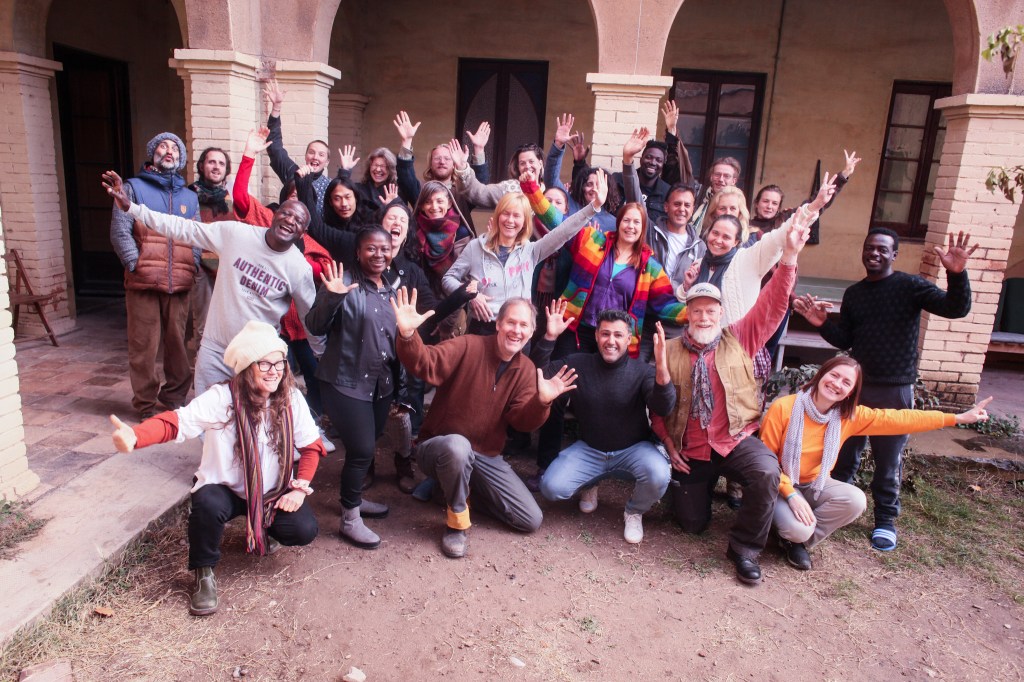
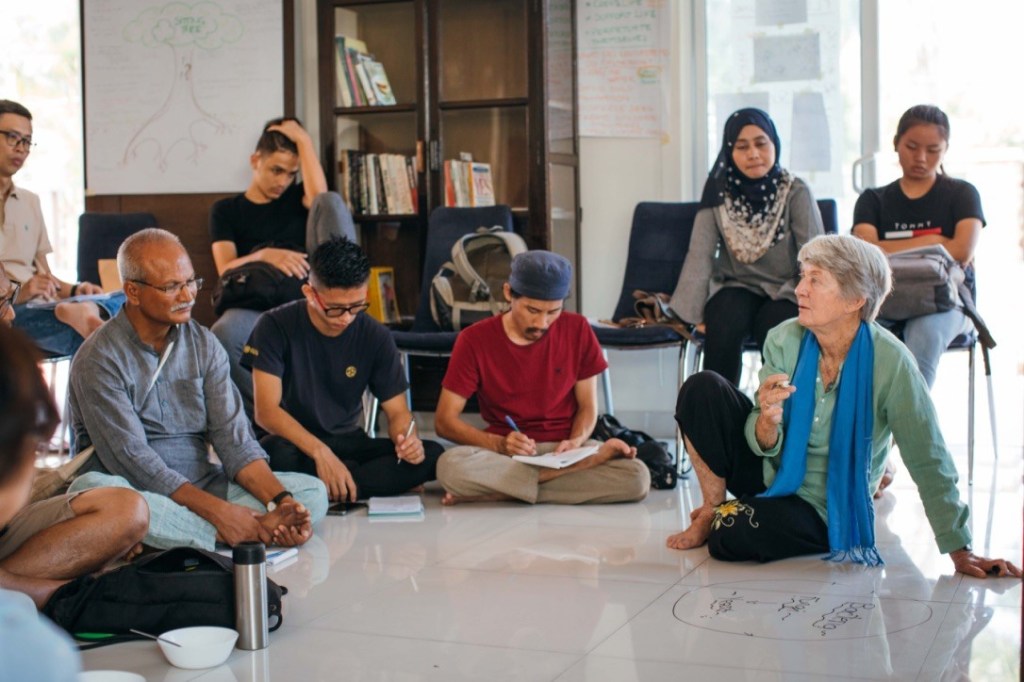
Permaculture For Refugees (P4R) is an organization that seeks to sustain livelihoods and ecosystems by inspiring sustainable permaculture practices in refugee camps and communities globally.

In the past, peacebuilding efforts by P4R have aided refugee communities around the world including in East Africa and Bangladesh. Following a year of global conflict, their teachings have been more essential than ever to the many displaced by strife and violence in domestic and international settings.

With strong historic and continuing support from Australian Quakers, P4R is now working to support permaculture practices and practitioners in the Middle East with a specific focus on Gaza. In addition, in Myanmar their network is setting up refugee schools with permaculture instruction for ethnic minorities from Malaysia. A new permaculture teacher training in Spain is occurring with a focus on refugees and a Ukrainian ecovillage has been providing news of their permaculture instruction.

Ruminating on ruminants

John Meadley has spent a lifetime, since 1968, engaged with rural communities in Africa, Asia and the Caribbean.  Many of these communities are materially poor, although culturally and spiritually rich, and experience hunger.  Reflecting this, some 16 years ago he felt increasingly uneasy about the feeding of large amounts of grains and pulses to farm animals – particularly to ruminants (which include cattle, sheep, goats and buffaloes) for whom this is not their natural diet.   A chance conversation with two British farmers who were already raising their cattle and sheep wholly on pasture led to the decision to encourage other farmers to do the same.  A small gathering shortly afterwards in Cheltenham Meeting House discussed the way ahead.  One of the key decisions was to be non-judgemental, which proved to be pivotal to what followed. 

Out of this initial meeting has emerged the Pasture for Life movement, which champions the restorative power of grazing animals on pasture.  Now with approaching 1,500 members (mainly farmers but also vets, academics, butchers and restauranteurs) spread across the UK and into Ireland it has an extensive outreach programme, with over 130 events last year. A strong research programme works with academic institutions both in the UK and mainland Europe – led by a team of three post-graduate-trained farmers – all of whom are women.

Encountering a lot of resistance, in 2016 the publication Pasture for Life: It Can Be Done was a turning point through providing a blend of inspiring stories and hard economic data that showed that raising ruminants wholly on pasture can be both ecologically sound and financially profitable.   A series of case studies from 30 farms has demonstrated how grazing animals can nurture biodiversity, summarised in this article on Biodiversity and the Grazing Ruminant to which an introduction can be found here.

The world’s soils hold more than three times as much carbon as is in the atmosphere.  Two thirds of the world’s farmland is under pasture, making the soil beneath it the world’s largest single terrestrial store of carbon.  When soil is cultivated to produce the cereals and pulses on which we all depend its structure is damaged, the life in the soil is diminished and organic matter is lost to the atmosphere as CO2. Since time immemorial, farmers have healed the soil by the planting and grazing of pasture – a practice that has been increasingly lost with the introduction of industrial farming but which is now being encouraged by Pasture for Life.


Pasture for Life has Quaker roots. Both John Meadley (John M) and one of the two co-founding farmers, organic farmer John Turner (John T), are Quakers.   “Quaker values have been built into the warp and weft of the movement” they note “with farming being seen as a two-way conversation with nature”.  John T remained closely involved for several years before moving on to play a pioneering role in the development of Population (heterogeneous) Crops within British farming – about which more another time.  Latterly John M has also stood back to allow a strong team of farmers to take over the strategic and operational running of the movement, confident that reverence for nature is, and will remain, integral to its ethos.  For more information, watch this short history of Pasture for Life.”

Fig & Ishka – Illustrations to Inspire Hope

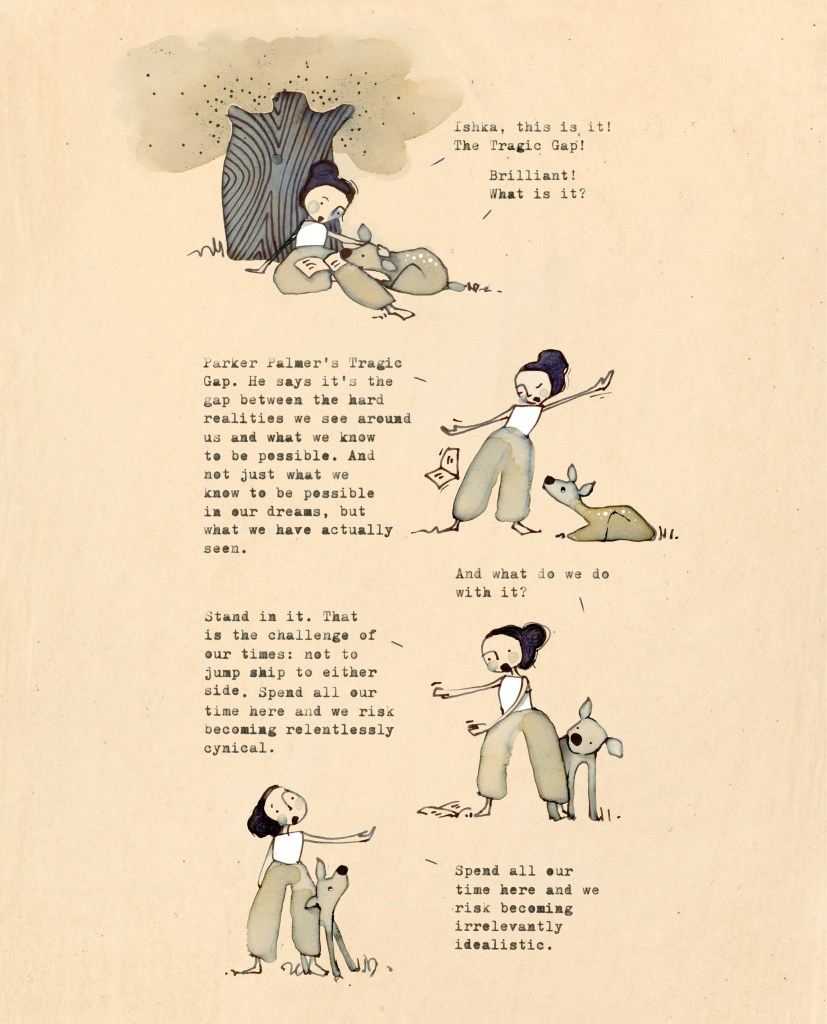
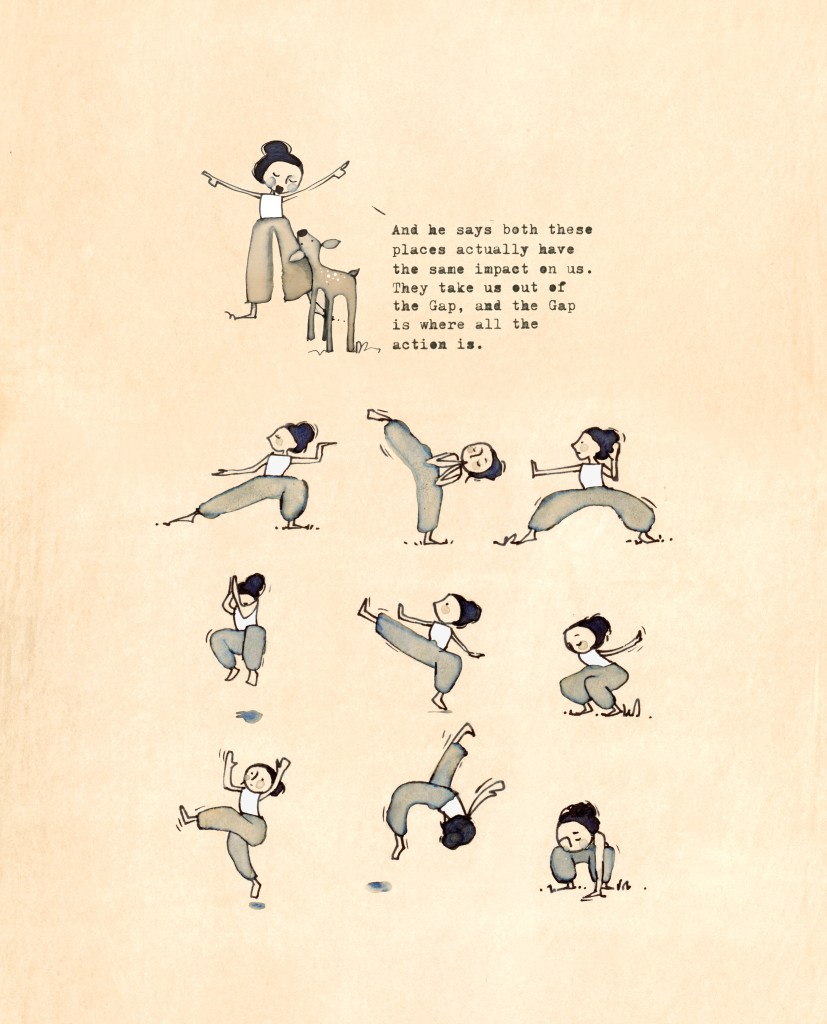
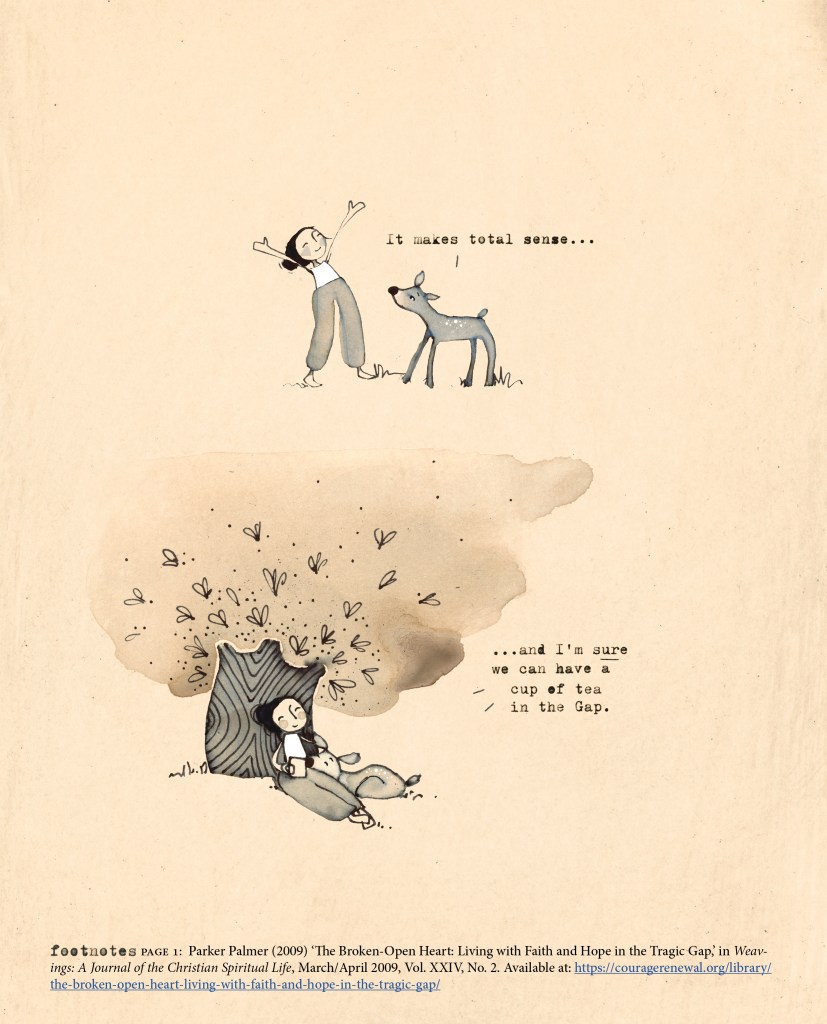
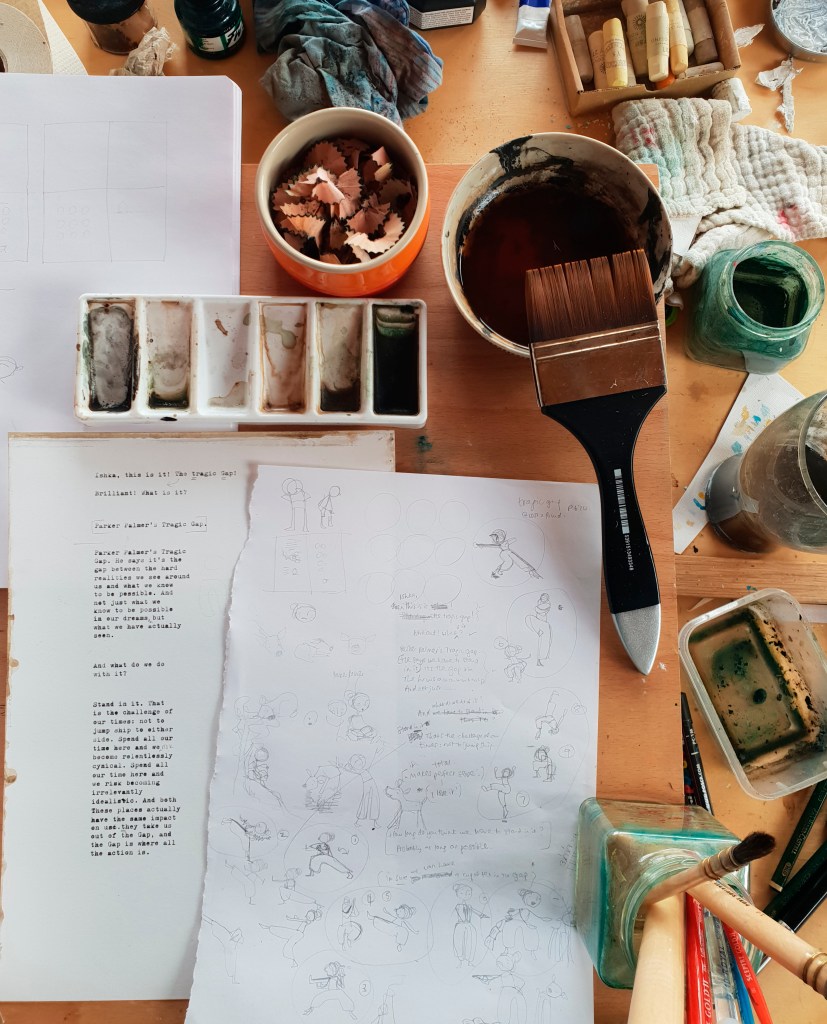
Lynn Finnegan, a Quaker based on the north coast of Ireland, is doing a year-long art and storytelling project called Fig & Ishka. It involves illustrated stories about two friends who paddleboard, grow food, read, hike, and sit around the fire together. They are also trying to show up to the world’s current ecological and social crises without jumping ship to complacency, cynicism or despair. Fig & Ishka often draws upon wisdom found in the teachings of Quakerism, systems thinker and activist Joanna Macy, and Buddhist Zen master Thich Nhat Hanh. 

The illustrations are done with tea, ink, water and her dad’s old typewriter. They are released every Friday for one year, starting from February 2024: you can browse them all, and subscribe to new weekly posts, at www.lynnfinnegan.substack.com.

website: www.lynnfinnegan.ie 

instagram: @lynn.finn.egan

Quaked United Nations Programme Assistant Applications Now Open

Applications are now open for three programme assistant positions at the Quaker United Nations Office (QUNO), in Geneva, Switzerland. The three programmes currently seeking assistants are Human Rights & Refugees, Peace & Disarmament, and the Human Impacts of Climate Change.

The programme assistant position is an exciting opportunity for young professionals who are interested in working in international affairs. The position provides individuals with the opportunity to learn about and contribute to Quaker work at the UN.

Open to Quakers and those in sympathy with Quaker values, QUNO is receiving applications from now until the 20th of April 2023.

For more information and to see the jobs’ full descriptions, click here.

Quaker United Nations Summer School Applications Now Open

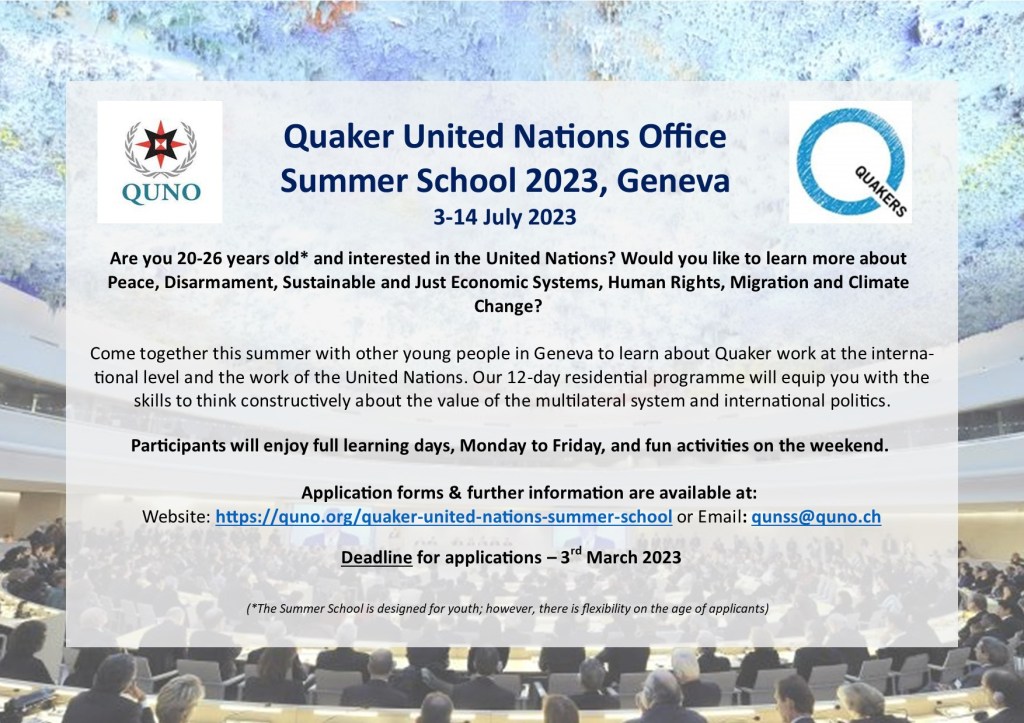
The Quaker United Nations Office’s summer school program returns in person from 3-14 July 2023. Taking place at the heart of international governance, the 12-day residential program in Geneva is an opportunity for young people to learn about QUNO’s work, multilateral governance, and some of the most pressing international politics of our day, including the climate crisis. Apply by March 3rd. Click here to learn more about the program. Applications and reference letters can be accessed here.

All Change! Making paths on shifting ground

The Closing Minute of the Living Witness Gathering at Woodbrooke, 26-29 August 2022


We are 63 Quakers gathered from across Britain, with a sense of urgency and under concern.
Addressing all Friends, as far as we can reach. We will outline our experience, own our own response, and issue a call to action.


We have heard clearly, with hope and excitement as well as fear and grief, an acute sense that this is an extraordinary time – a time of enormous challenge which can change us profoundly in ways we need to change. It is the great, holy work of our time, it is our privilege to be part of it and we must prepare our spirit for what is coming.


The climate and ecological crisis changes everything.


We value the work which is being done by Yearly Meeting staff and Woodbrooke on climate justice and encourage Friends to participate. We also see clearly that there is a need for grassroots action/response to the climate and ecological crisis in addition to that currently embodied in YM and Woodbrooke structures.


Local and area meetings are aware of the urgency and much is happening, both within Quakerism and beyond. Meeting for Worship isn’t just a place to feel comfortable, but a crucible in which we scrutinize our lives and see how they can be aligned more closely to our faith.


Arising from this gathering we know that there isn’t one right thing to do, the important thing is to do our best, and not give up. We each commit to listen to each other, love and support each other, work and worship together. We will find ways to ground ourselves and heal ourselves, and build resilience and inclusion wherever we can.


We carry forward from this gathering many strands of work, both large and small. We recognise that injustice in the ownership and control of resources raises questions about our entire political and economic system. We commit to work with children and young people; we have a concern to address the current cost-of-living crisis, including offering our meeting houses as warm refuges; we make a commitment to support those taking direct action; we will respond to promptings to work more on food and biodiversity; and we are led to support local communities in becoming carbon neutral, alongside many other ideas and actions.


We believe Faith groups can take a lead which will help the nation listen, and Quakers must play our part in this. We would like to see an Interfaith commitment to climate justice leading up to the next general election so that incoming government is clearly focused on this issue.


The last time Quakerism renewed itself was the 1895 conference which became the basis of 20th century liberal Quakerism. Quakers had to reorientate their faith.


Today, we are a similar position. Rather than evolutionary science tearing up our sense of the past, we hear the prophetic voice of the Intergovernmental Panel on Climate Change that is tearing up our sense of the future and ending the notion of the inevitability of growth.


The science and the events it chronicles, together with our increasing awareness of the legacy of extractive colonialism, are once again calling on us to renew our faith. This is the context of our gathering. We open ourselves to this pregnant sense of the present. Quakers and Living Witness can be midwives of the spirit.


The universe is participatory, there are no bystanders. Our commitment to climate justice encourages us to see everything we do as something which is of god or against god. We are called to be whole with creation and act on the Truth which we find.
Quaker Institute for the Future prepares inspiring EPISTLE for Friends worldwide

Background:

The Quaker Institute for the Future (QIF) was established in 2003 inspired by Kenneth Boulding’s Quaker Studies on Human Betterment and his call for a research institute focused on the future. QIF has sponsored a series of collaborative research projects, including an annual Summer Research Seminar, and published research findings in thirteen books <quakerinstitute.org>. In cognizance of humanity’s (and our planet’s) current climate emergency, QIF’s Board of Trustees recently approved an inspiring epistle using the following language: “As the world has gone from climate change to climate crisis to climate emergency, we, the QIF Board of Trustees, find that climate change affects every aspect of our work. The time in which nations and citizens of the world can yet act to mitigate the worst effects of climate change is rapidly vanishing. In the spirit of Quaker tradition, we have prepared this epistle in the hope that it may inspire Friends in solidarity with truth seeking and in their discernment on witness and action.”

The Epistle [LINK]

Magpie Art Collective’s Quaker Peace Doves

Magpie is the Barrydale based art collective by artists and social entrepreneurs Scott B. Hart and Shane A. Petzer. Working in their studio and gallery in the Western Cape of South Africa, Scott and Shane produce art, craft and bespoke creations centred around their commitment to “meaningful commercial and social entrepreneurism, integrated with environmental concern.”

During the first Covid-19 lockdown in March 2020, Magpie developed a new project on the Quaker Peace Dove. The collective ran online making workshops in collaboration with Cape Western Monthly Meeting, during which Friends joined together via Zoom to create “#QuakerPeaceDoves” using a template created by Magpie. The doves are made of recycled milk bottles, hence the title of the series: “Turn Your Lockdown Trash Into Art.” Shane writes that the doves were conceptualised as:

“a unifiying symbol around peace and environmental/climate justice concerns [and provide] an example of how we can use art as a social tool.”

The workshops also created an online space for Friends to gather and share during the pandemic, an opportunity that was important for the artists who have long been involved in creating work that places social concern and community at its heart. For more information, and contact details visit http://www.magpieartcollective.com. Images of the work featured above can also be seen via Magpie’s social media channels.

Loughborough Quakers Sustainability Handbook

Quakers in Loughborough, UK have published a Sustainability Handbook, advising Friends on lifestyle changes they can make to live more sustainably.

The project includes a range of approaches to sustainable living and contains contributions from almost every member of the meeting. It also includes a Resource section of tips on how to shop locally and sustainably in the surrounding areas. Friends’ reflections are accompanied by illustrations from artist Miriam Bean. Read below for some of the contributors’ experiences and reflections on producing the handbook and view the online version here. Requests for physical copies of the Handbook can be sent to Julian Rees.

“I was invited to a weekend at Bamford by members of Loughborough Quakers, to spend time reflecting on the environment and how we can each contribute positively to sustainable living. There have been many challenges to my thinking and lifestyle, but I really appreciate being able to share these with a group of like-minded Friends, especially as sustainability is becoming more and more prevalent in the news.” – John Bean

“I’ve seen sustainability issues as crucial since I joined Greenpeace and Friends of the Earth in the 1970’s.  I’ve been part of various groups including Living Witness in British Quakers, being founder member of Loughborough Transition, facilitator for Carbon Footprint Support Groups, and part of team who set up an Area Meeting One Planet Living Group a few years ago, now laid down. It’s been a particularly heartwarming time in my sustainability journey when Loughborough Meeting developed its active Sustainability Group. There had been previous attempts which withered after a short while. It is so affirming now to be part of a committed group, and with the Quaker ethos.” – Sue Meredith Velado

“The climate crisis is a huge and daunting issue and it is easy to feel overwhelmed by it. Working in a group with others to make changes, no matter how small, made me feel less helpless. Creating the Loughborough Sustainability Handbook was such an affirming experience because it brought the Meeting together in a shared project and made me feel we were making a difference.” – Julian Rees