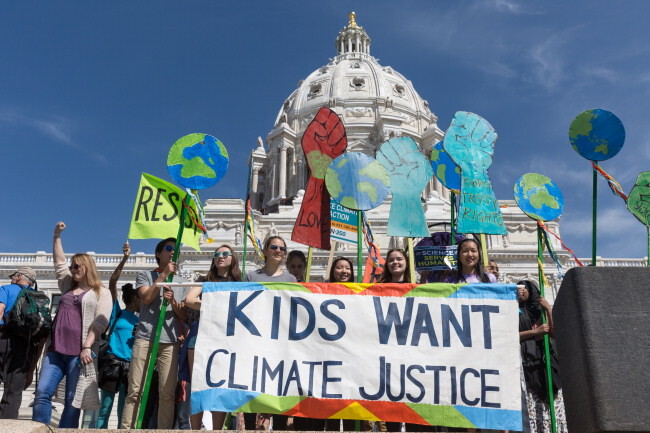
Image courtesy of Environment Magazine: Wikimedia Commons / Lorie Shaull
QUNO shares news that a briefing paper developed and released last year with input from the Human Impacts of Climate Change (HICC) program was adapted and published in the academic journal, Environment: Science and Policy for Sustainable Development. The article is available and accessible online here, presenting QUNO research and findings in a condensed format for a large audience of scientific and policy experts.
The paper, “Carbon Dioxide Removal: What Is Sustainable and Just?” was written by Dr. Duncan McLaren and Dr. Olaf Corry and published under the same title in 2024 on the QUNO website. Originally envisioned, commissioned, and edited by QUNO, it evaluates the ethical, environmental, political, and justice dimensions of large-scale implementation of carbon dioxide removal (CDR) technologies.
Environment: Science and Policy for Sustainable Development publishes bimonthly editions for a wide readership on topics related to environmental science and policy. During the adaptation process, editorial review and expertise were shared by Steven Kolmes and Tim O’Riordan, editors at the journal. With a readership represented by over 100,000 annual downloads, Environment magazine is a prestigious home for environmental research and QUNO celebrates the authors and the ongoing impact of their work.
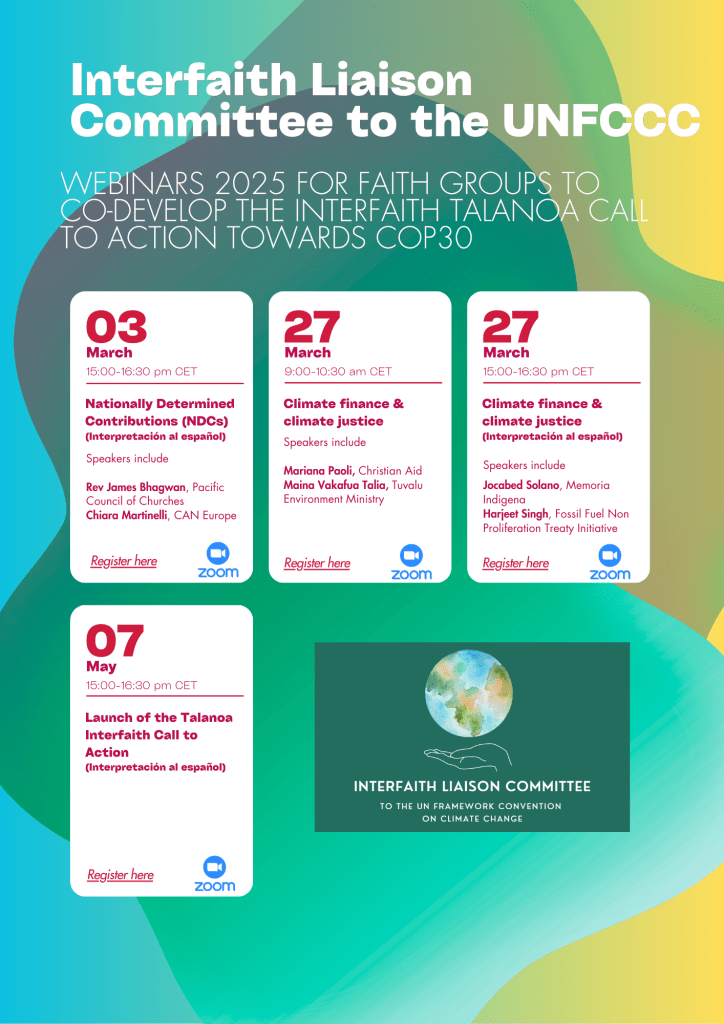
The Interfaith Liaison Committee, is organizing a webinar series in spring 2025 and invites all interested individuals and interfaith organizations to attend and co-develop the Interfaith Talanoa Call to Action towards COP30.
Don’t hesitate to join this opportunity to make your voice heard, and to share this invitation with others.
Please find the invitation for the ILC series of webinars towards COP30 here.
Individual registration links for each webinar in the series are available as well below:
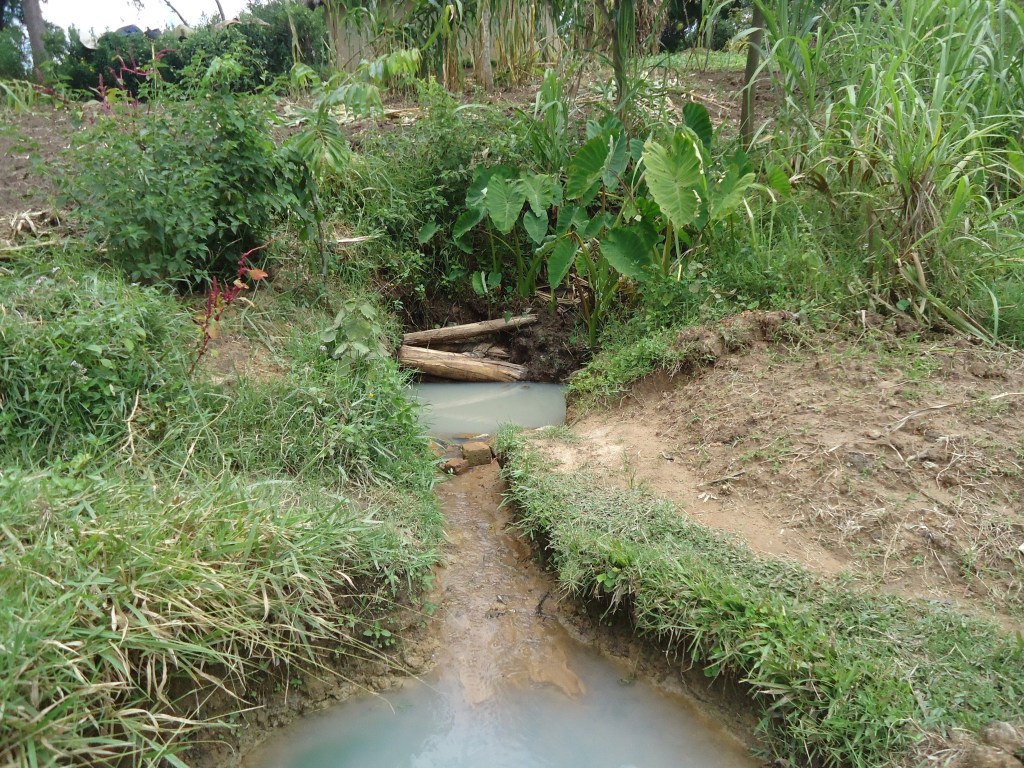
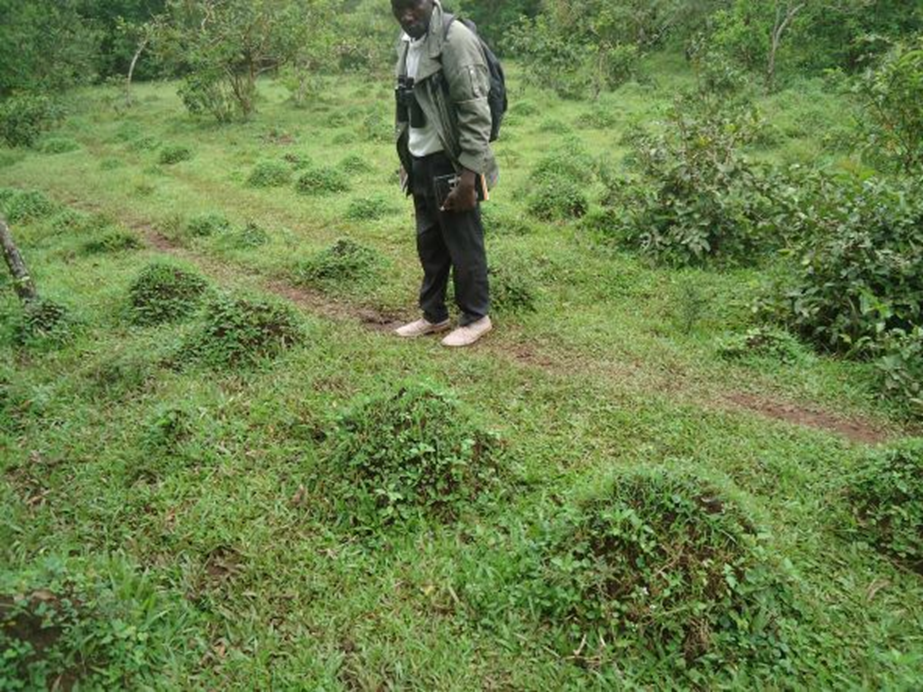
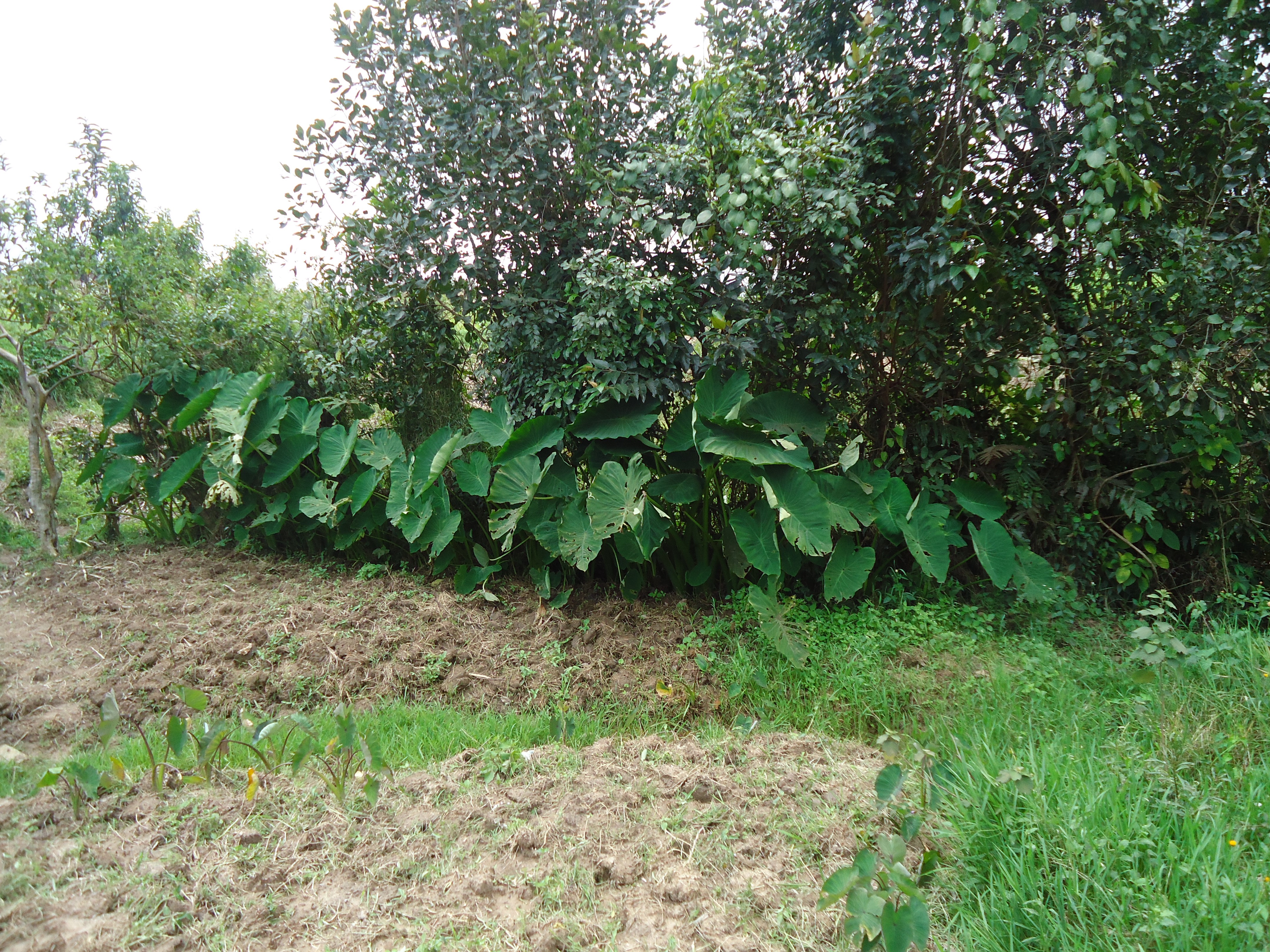
Quakers United for Environmental Sustainability Program (QUESP) is a new initiative formed by members from the Malava Yearly Meeting and led by Jairus Koki. Their mission is “To be true Stewards of God’s Creation through actions to combat climate change”. The formation of the program is inspired by concerns about the adverse effects of climate change affecting communities in Western Kenya, including changing rain patterns, failure of crops leading to increased food insecurity, and the destruction of water catchment areas.
Members of the group feel that they have a duty to combat the negative effects resulting from climate change by taking responsibility for the care of the world that God bestowed to us in Genesis as stewards. These effects have left Quaker churches, schools, and homes bare without trees and natural vegetation, even lacking shade to sit under when it is hot. Many indigenous trees that were known to provide shelter and conserve water catchment areas have either been uprooted or cut down for charcoal.
QUESP members feel obliged to be stewards of God’s creation and help restore it. Though still a new organization, they plan to realize this mission through several activities, including visiting churches (of Quakers and non-Quakers) to spread awareness on taking care of God’s creation; documenting indigenous methods of environmental conservation; undertaking tree nursery development and management training, and by supporting tree seedling plantings to restore destroyed habitats. QUESP is in the process of registration and hopes to achieve these dreams with the help of like minded friends.
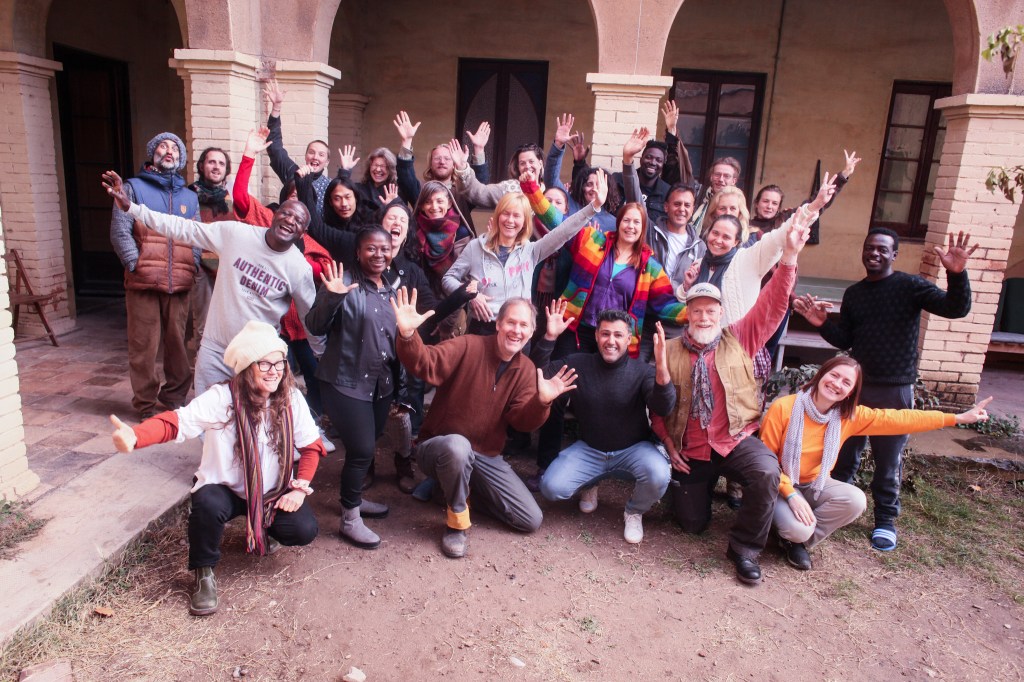
Permaculture For Refugees (P4R) is an organization that seeks to sustain livelihoods and ecosystems by inspiring sustainable permaculture practices in refugee camps and communities globally.
In the past, peacebuilding efforts by P4R have aided refugee communities around the world including in East Africa and Bangladesh. Following a year of global conflict, their teachings have been more essential than ever to the many displaced by strife and violence in domestic and international settings.
With strong historic and continuing support from Australian Quakers, P4R is now working to support permaculture practices and practitioners in the Middle East with a specific focus on Gaza. In addition, in Myanmar their network is setting up refugee schools with permaculture instruction for ethnic minorities from Malaysia. A new permaculture teacher training in Spain is occurring with a focus on refugees and a Ukrainian ecovillage has been providing news of their permaculture instruction.
John Meadley has spent a lifetime, since 1968, engaged with rural communities in Africa, Asia and the Caribbean. Many of these communities are materially poor, although culturally and spiritually rich, and experience hunger. Reflecting this, some 16 years ago he felt increasingly uneasy about the feeding of large amounts of grains and pulses to farm animals – particularly to ruminants (which include cattle, sheep, goats and buffaloes) for whom this is not their natural diet. A chance conversation with two British farmers who were already raising their cattle and sheep wholly on pasture led to the decision to encourage other farmers to do the same. A small gathering shortly afterwards in Cheltenham Meeting House discussed the way ahead. One of the key decisions was to be non-judgemental, which proved to be pivotal to what followed.
Out of this initial meeting has emerged the Pasture for Life movement, which champions the restorative power of grazing animals on pasture. Now with approaching 1,500 members (mainly farmers but also vets, academics, butchers and restauranteurs) spread across the UK and into Ireland it has an extensive outreach programme, with over 130 events last year. A strong research programme works with academic institutions both in the UK and mainland Europe – led by a team of three post-graduate-trained farmers – all of whom are women.
Encountering a lot of resistance, in 2016 the publication Pasture for Life: It Can Be Done was a turning point through providing a blend of inspiring stories and hard economic data that showed that raising ruminants wholly on pasture can be both ecologically sound and financially profitable. A series of case studies from 30 farms has demonstrated how grazing animals can nurture biodiversity, summarised in this article on Biodiversity and the Grazing Ruminant to which an introduction can be found here.
The world’s soils hold more than three times as much carbon as is in the atmosphere. Two thirds of the world’s farmland is under pasture, making the soil beneath it the world’s largest single terrestrial store of carbon. When soil is cultivated to produce the cereals and pulses on which we all depend its structure is damaged, the life in the soil is diminished and organic matter is lost to the atmosphere as CO2. Since time immemorial, farmers have healed the soil by the planting and grazing of pasture – a practice that has been increasingly lost with the introduction of industrial farming but which is now being encouraged by Pasture for Life.
Pasture for Life has Quaker roots. Both John Meadley (John M) and one of the two co-founding farmers, organic farmer John Turner (John T), are Quakers. “Quaker values have been built into the warp and weft of the movement” they note “with farming being seen as a two-way conversation with nature”. John T remained closely involved for several years before moving on to play a pioneering role in the development of Population (heterogeneous) Crops within British farming – about which more another time. Latterly John M has also stood back to allow a strong team of farmers to take over the strategic and operational running of the movement, confident that reverence for nature is, and will remain, integral to its ethos. For more information, watch this short history of Pasture for Life.”
QUNO has released a new resource guide on the Human Right to a Clean, Healthy, and Sustainable Environment (R2He) to celebrate the recently recognized right. This easy-to-read guide answers 8 questions to help empower each of us as individuals and members of our communities to advocate for our rights, participate in decision making, and hold our governments to their agreed responsibilities.
Over 85% of UN Member States recognize a right to a healthy environment in either constitutions, legislation, or regional treaties. Recognition of this human right means states have the obligation to uphold and protect this as enumerated. If and when they do not, we can work for its proper implementation.
Johan Cavert, Programme Assistant for the Human Impacts of Climate Change at the Quaker United Nations Office, reflects on his experience of United Nations climate change talks. (This piece is reposted from Britain Yearly Meeting. The original can be found here.)
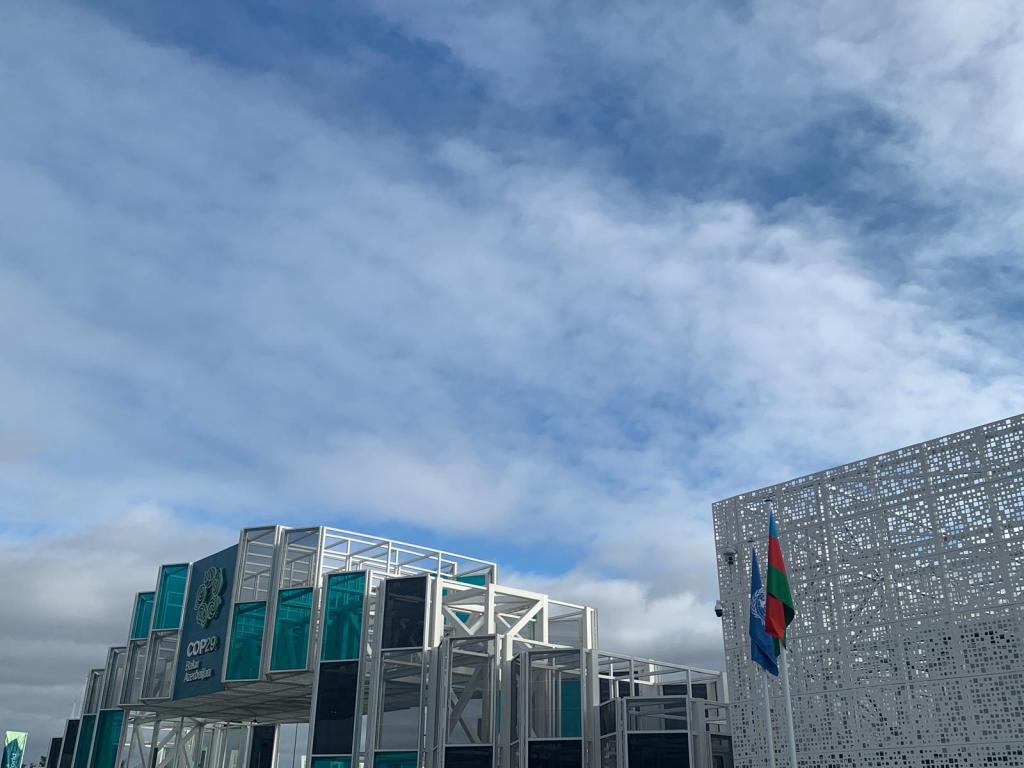
Arriving at the UN climate change talks (COP29) in Azerbaijan, a clarion of trumpets and beating drums echoed from large speakers, heralding the entrance to the conference complex. Listening each morning reminded me of the insistent and repeated demands from civil society and observers calling for just and equitable climate finance.
At the same time, I was struck by the large temporary tent city constructed for the over 60,000 attendees who traversed the conference halls. Surrounded on all sides by artificial construction, it was hard not to notice the ways in which – literally and figuratively – negotiations in Baku resembled a circus. Pageantry is at times necessary and the symbolism of the United Nations Conference of the Parties (COP) cannot be denied. Nonetheless, bread and circuses will no longer be sufficient for those seeking justice.
A concerning COP
A clear call to increase financing for the most vulnerable was sounded repeatedly at COP29. It frequently went unheeded. Throughout two weeks of heated negotiations, states remained at loggerheads over the primary issue being discussed – how much money to commit for the New Collective Quantified Goal for climate finance (NCQG).
Developing countries demanded over US$1.3 trillion in grants be paid each year by developed countries. For their part, developed countries avoided committing to any numbers until the eleventh hour, and only then proposed a figure and language that was highly disappointing. Well more than 24 hours overtime, states adopted a text that failed to advance significant action addressing the climate crisis.
In addition to this being my first time attending COP, it was also my first experience observing international negotiations. I left Baku inspired by the global solidarity and commitment displayed by a wide array of individuals and organisations. At the same time, I came away discouraged by the apparent lack of urgency in the multilateral process.
I was not the only participant whose faith in global governance came away bruised. Many speakers underlined that this was the 29th iteration of annual negotiations and yet increases of carbon emissions continue. Amidst proceedings, a group of distinguished global leaders released an open letter which called into question the hosting process, given the past two COPs have been led by economies highly dependent on fossil fuels. Azerbaijan’s COP Presidency was already a focus of concern before the conference began, due to a report showing how the Presidency saw the event as an opportunity to sign oil and gas deals. Modernist skyscrapers along Baku’s coast tower over the oil fields of the Caspian sea, displaying the connection between the country’s economic wealth and its longstanding reliance on fossil fuels. President Ilham Aliyev said the quiet part out loud when he stated that Azerbaijan’s fossil fuel resources are “a gift from God”.
Inspiring action within a flawed system
Azerbaijan was also criticised for its rights record and unjust detention of government critics and environmental human rights defenders. I was grateful to participate in the human rights and climate change working group which worked to publicise demands for a more open and inclusive space for civil society. Actions at the conference were restricted to pre-assigned spaces and detailed requirements were imposed on messaging and speech.
Having been refused the chance to sing or chant during one action, participants instead hummed together in a creative act of melodic resistance. The limited number of delegate slots available and the difficulty in travelling to Baku highlighted the impact of those in attendance. At the same time, it was inspiring to realise that those on the ground were just the tip of the iceberg of a global movement.
In the midst of insufficient political will, we must continue to work for meaningful progress from international negotiations while remaining clear that national action and advocacy are essential to international success. The circus atmosphere that at times pervaded Baku only underlines the importance of speaking honestly about the role power and influence play in perpetuating systems of injustice.
A Quaker presence at COP is an important witness that care for creation involves living sustainably and in just relationship with the earth. The call for climate justice and equitable financing has been broadcast clearly. It must be echoed and acted on.
Lindsey Fielder Cook, Interim Deputy Director and Representative for the Human Impacts of Climate Change at the Quaker United Nations Office, reports back from COP29. (This piece is reposted from Britain Yearly Meeting. The original can be found here.)
The atmosphere during the recent climate change Conference of Parties 29 (COP29) in Baku, Azerbaijan, at times felt ominous. Trust between countries, always fragile, received hard blows.
Photo credit: Simon Chambers/ACT
The wider political influences
At its core, the COP29 was about increasing financial commitments from developed to developing countries, at a time when the wealthiest and highest greenhouse gas (GHG) emitting developed country was likely to leave the process. More widely, the COP was held in a dangerous time for international relations. Powerful member states threaten use of nuclear weapons, block ceasefires and remain silent over a plausible case of genocide and attacks on UN agencies, openly reject the highest legal voices (International Court of Justice and International Criminal Court), and systemically underfund multilateral bodies while global military spending now surpasses 2.4 trillion USD. The COP29, like the recent UN Summit of the Future in September, the biodiversity COP and negotiations for a treaty on plastic pollution, have all been affected.
The COP29 began with host nation Azerbaijan referring to fossil fuels as a “gift from God”. In the negotiation room, countries discussed greenhouse gas (GHG) emissions mitigation, yet nearly every fossil fuel wealthy country in the room planned oil and gas production increases which would eliminate chances for a 1.5°C global temperature rise limit.
The denial in the room is no longer about the dangers of climate change – this is agreed. The denial now regards the ‘how’ as countries look to false solutions including geo-engineering. Too few decision makers are ready to honestly address root causes driving planetary crises in our unsustainable and inequitable energy, economic and agriculture systems. Nonetheless, there are some brave actors in the room including Colombia, which announced a cap on fossil fuel extraction. Meanwhile the UK reiterated Labour’s manifesto commitment to cap new oil and gas licenses.
What was agreed, what is at stake
Leading up to the COP29, negotiators had three years to prepare a new collective quantified goal for climate finance (NCQG), set to replace and update the ‘100 billion USD a year by 2020’ promise critical to establishing the 2015 Paris Agreement. However, that 100 billion USD a year did not materialise fully until after 2020, and harmed trust in this process.
Over the years, civil society including the Quaker United Nations Office and Quakers in Britain have proposed approaches that would make polluters pay, including fair sources of finance for loss and damage (PDF). The Paris Agreement committed developed countries to lead on financing and mitigation; they have the highest per capita GHG emissions, the highest historical emissions, and in most cases benefited financially from colonisation.
However, at the COP29 we witnessed stand-offs, last minute drafts, selective sharing, walkouts, and final language mirroring the last ineffective finance deal. Specifically, inclusion of the word ‘by’ in the clause “with developed countries taking the lead, of at least USD 300 billion per year by 2035″. The ‘by’ allows 11 years for full delivery. The text also contains no clear commitment to protect sufficient grants rather than loans that exacerbate debt, it includes many references to private finance over public finance, and no analysis on the diluting impact of inflation.
There were decisions relating to the Global Goal on Adaptation, though again without sufficient funding. A decision to extend the enhanced Lima work programme on gender was met with efforts to weaken previously agreed language relating to gender and human rights language. Finally, there were decisions on guidelines for implementation of carbon markets proposed in Articles 6.2 and 6.4 of the Paris Agreement. Carbon markets are not supported by most civil society voices at the COP29. They are essentially ‘carbon offsetting’ for high GHG emitters failing to sufficiently mitigate their own emissions. Carbon markets do not reduce greenhouse gas emissions ‘at source’, have a history of ineffectiveness, abuses of Indigenous Peoples and human rights, and fail to recognise increase of eco-system collapse under rising temperatures.
Quaker action at COP29
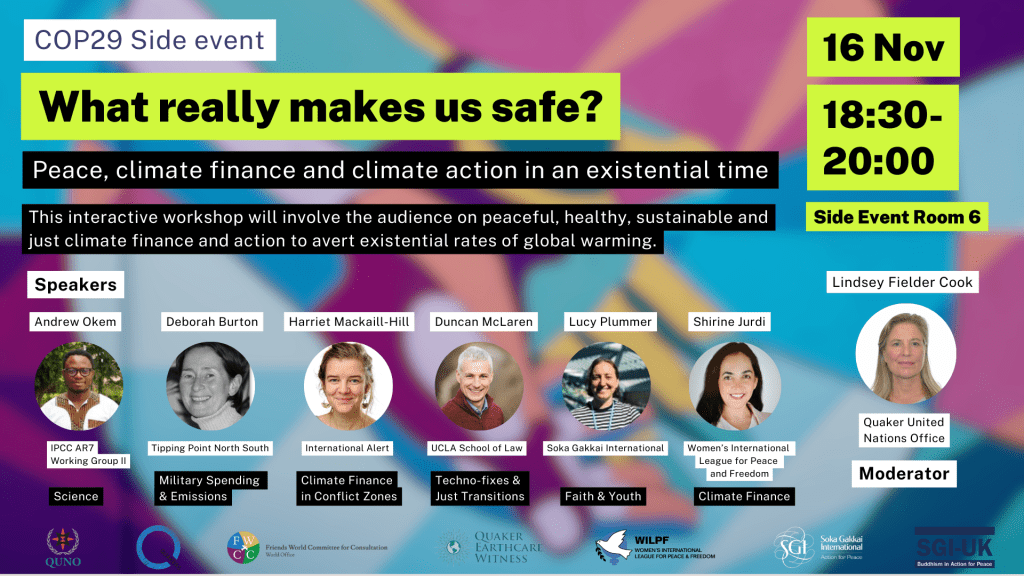
At the COP29 we prepared and translated toolkits for negotiators on the latest climate science, and booklets for grassroots action on ‘what we can do’. We distributed a briefing paper on the risks of geo-engineering reliance on carbon dioxide removal (CDR). We helped author an interfaith statement for the COP and helped plan and facilitate an interfaith Talanoa Dialogue with faith voices from around the world. We coordinated Quaker voices in global civil society demands for the COP Presidency to protect human rights in climate action. We co-hosted with Quakers in Britain and Quaker Earthcare Witness an official COP event titled, What Really Makes us Safe?, and in a COP Press Conference asked the same question before journalists: why do we beg for climate finance to support needed root cause transitions and help people experiencing loss and damage, while trillions are spent on weapons to oppress and kill? Throughout, we met with a diverse group of negotiators to talk through hopes and concerns, as part of our quiet diplomacy efforts here to build communication between countries.
We hold to Quaker testimonies as a clear witness to peace and justice. “Do not be afraid to say what you have found and what you value.” As Quakers, we can bring vision to overcome fear. A vision of transformations which promote clean air, clean water and healthy wildlife, promote public transport, public health and education, promote clean and more equitably owned renewable energy, sustainable and just economic systems, more equitable societies, restorative agriculture and healthy diets. The story of Care for Creation – to walk cheerfully in this world, a witness to love not fear, to regeneration not destruction.
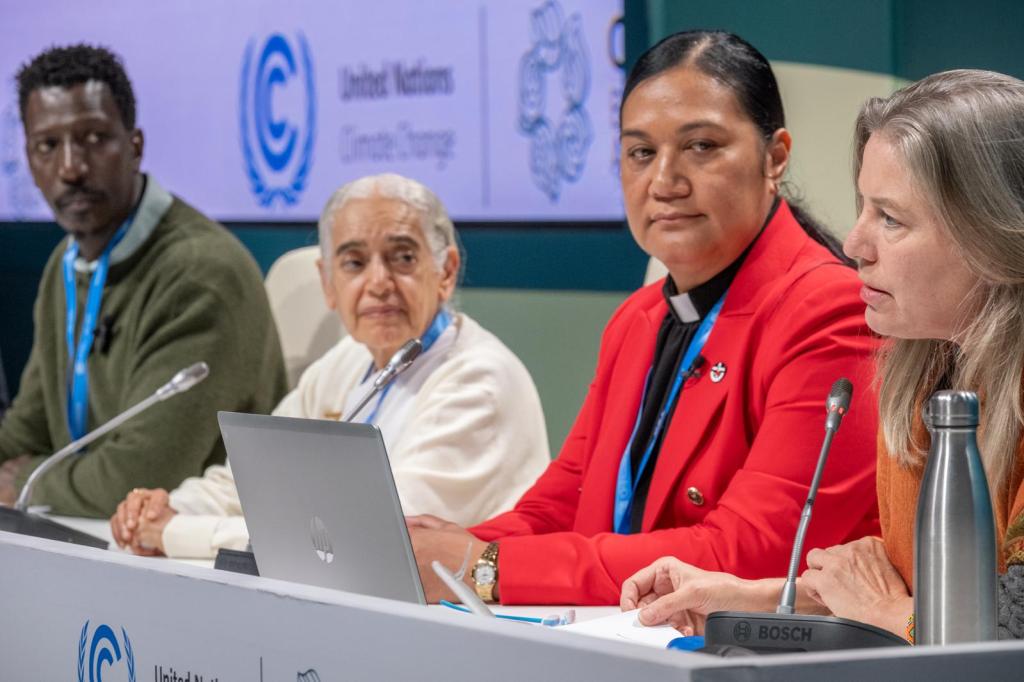
In collaboration with a number of Quaker and Interfaith organizations, QUNO co-hosted a side-event at the COP29 climate conference in Baku, Azerbaijan discussing the theme: “What really makes us safe? Peace, climate finance and climate action in an existential time”. An expert panel involved the audience in a conversation touching on peaceful, healthy, sustainable and just climate finance and action to avert existential rates of global warming
The event was moderated by QUNO’s Interim Deputy Director and Representative for the Human Impacts of Climate Change, Lindsey Fielder Cook. The panel featured an array of speakers from across the globe including the following experts:
Shirine Jurdi, Women’s International League for Peace and Freedom (Lebanon)
Deborah Burton, Tipping Point North South
Andrew Okem, IPCC (Head of Science of the IPCC Working Group II Technical Support Unit)
Lucy Plummer, Soka Gakkai International
Harriet Mackaill-Hill, International Alert
Duncan McLaren, UCLA Law School
The event was co-sponsored by Friends World Committee for Consultation, Quaker Earthcare Witness (QEW), Soka Gakkai International – UK (SGI-UK), Soka Gakkai International Office for UN Affairs, Women’s International League for Peace and Freedom (WILPF), and Quakers in Britain.
It took place on Saturday, November 16, 2024 at 6:30pm local time. A recording of the event was made by the UNFCCC and can be accessed on YouTube here.
QUNO’s Human Impacts of Climate Change programme has published a new briefing paper titled “Carbon Dioxide Removal (CDR): What is Sustainable and Just?”. Written by Dr. Duncan McLaren (UCLA, USA) and Dr. Olaf Corry (University of Leeds, UK), two academic experts on environmental law, international politics and geoengineering, this briefing paper is a key resource for understanding the risks of reliance on CDR.
The paper provides an overview of carbon dioxide removal practices and risks, and evaluates if there are just and sustainable levels for the use of these methods and technologies. Discussing geo-political, ethical and equity consequences to the mitigation choice of CDR, it highlights uncertainties surrounding the prospects of implementing large-scale CDR and the role it could play in threatening biodiversity and human rights. Exploring false narratives and misleading climate modelling portraying large-scale CDR reliance as a ‘techno-fix’, the authors ask what is ‘sustainable and just’, what is unsafe, and highlight approaches which can equitably and effectively transform root causes while avoiding reliance on unsustainable and unjust techno-fixes.
This is a critical issue, one increasing in importance as the costs and assumptions associated with CDR are reflected in climate models and governments lay out long term plans that increasingly rely on CDR approaches as opposed to reduction of root causes. This paper fills a crucial information gap by examining the feasibility, effectiveness, safety, sustainability, legality and ethics of CDR implementation.
This report was supported with grant funding from the European Climate Foundation. The publication and any conclusions contained within are those of the authors and do not necessarily reflect the positions or policies of the European Climate Foundation.

 QUAKERS & CLIMATE CHANGE WORLDWIDE